
If you make this trip every working day, you already know what it costs you. The distance is roughly 140 kilometres each way, and five round trips a week add up quietly. This guide is a straight comparison of the best ways to travel from Dubai to Abu Dhabi for regular commuters, not one-time visitors.
The distance itself is not the real problem. Sheikh Zayed Road (E11) and Sheikh Mohammed Bin Zayed Road (E311) are wide, well-maintained, and direct. What makes the journey difficult is the repetition, compounded by traffic at peak hours.
When you count the entire door-to-door trip, from walking across the car park to waiting for the elevator or catching a final local bus in Abu Dhabi, you can easily spend close to four hours a day just getting to work and back.
Dubai to Abu Dhabi travel time depends more on the hour you leave than on the road you take. A 7:00 AM departure and a 5:00 AM departure on the same highway are two different journeys. Some commuters lose the evening entirely and arrive home drained; others absorb it financially and only feel it when the month closes.
Commuters on this corridor fall into three broad groups: those who take public transport, those who drive themselves, and those who share the journey through an organised transport operator or an employer shuttle.
Option | Best suited to | Main limitation |
RTA intercity bus | Tight budgets, fixed hours, living near a station | Fixed timetables; last-mile leg needed in Abu Dhabi |
Your own car | Shift work, remote industrial areas | Highest running cost; driver absorbs all fatigue |
Organised commuter transport | Predictable cost, reserved seat | Fixed routes and stops |
Employer staff bus | Shifts outside bus hours | Depends on route coverage near your home |
Where you live, what you can spend monthly, and how rigid your schedule is will determine which option fits you. A commuter beside Ibn Battuta metro station faces a different set of choices from someone in Discovery Gardens with a 7:00 AM start.
Dubai’s Roads and Transport Authority runs intercity routes prefixed with E. The two main Dubai-to-Abu Dhabi services are E100 and E101. E100 connects Al Ghubaiba Bus Station with Abu Dhabi Central Bus Station; E101 connects Ibn Battuta Bus Station with Abu Dhabi Central Bus Station, as listed in the RTA official intercity bus route list. Which one suits you depends mainly on how easily you can reach the departure station.
A third route, E102, ends in Mussafah rather than central Abu Dhabi, which is useful if your workplace is in the industrial belt.
All bus payments run through the NOL card system. A new Silver card costs AED 25, which includes an initial AED 19 credit, and the fare deducts automatically when you tap to board. Because these buses rarely accept cash and the intercity fare is processed in a single transaction, you must always ensure you have a minimum balance of AED 25 before you travel.
The biggest sacrifice you make with the bus is flexibility. Suddenly, your evening revolves around catching the last departure rather than wrapping up your workday naturally. On top of that, the bus only gets you as far as the central station. Getting to your actual desk on Saadiyat Island, the Corniche, or in Mussafah requires another bus or a taxi. The local connections are definitely there, but adding another ride to the end of your trip just drags out an already long day.
Fuel will be your biggest expense. Since UAE pump prices reset on the first of every month, this cost is always changing. For example, at the September 2026 rate of AED 3.69 per litre for Special 95, a car driving 6,600 km a month (averaging 10 litres per 100 km) will burn through 660 litres. That lands your monthly fuel bill near AED 2,400.
Tolls add another heavy layer to that cost. Dubai’s Salik system now uses variable pricing: you pay AED 6 (plus 5% VAT) during weekday rush hours (6:00 AM to 10:00 AM and 4:00 PM to 8:00 PM), and AED 4 outside those times. If you commute during normal working hours, you will hit the higher rate in both directions. On top of that, Abu Dhabi’s Darb system adds another AED 4 per crossing during its own peak windows.
Hidden costs pile on even more. Racking up that much mileage accelerates your car’s depreciation, forces you to service the car more often, and drives up your insurance premiums. Then there is parking: Dubai’s premium zones cost AED 6 for the first hour during peak times, while Abu Dhabi’s Mawaqif charges up to AED 15 a day for standard bays, or AED 3 an hour for premium spots.
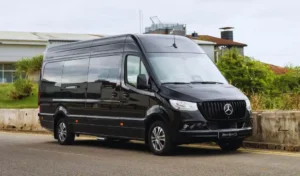
Organised commuter transport is a great middle ground between taking the bus and driving yourself. Licensed operators run cars and vans along fixed routes, picking you up at an agreed spot and dropping you near your office.
A Dubai to Abu Dhabi car lift usually runs on a monthly subscription. You just pick your boarding and drop-off points, pay a flat monthly fee, and commute with the same small group of people every day. Because the vehicle is dedicated to your route, you never waste time waiting in queues, which makes your overall morning routine much more predictable.
You will also find plenty of specialised options. Some operators offer a dedicated pick-and-drop service for ladies if you prefer to commute only with other women. Other companies run larger vans specifically for corporate teams or airport staff working awkward shifts that regular buses do not cover.
The only real downside is the lack of flexibility. If you have to work late, you might miss your ride. Always check how an operator handles missed trips and refunds before you lock into a monthly contract.
Many companies with offices in both emirates actually provide their own staff transport. You will see this everywhere, from banks and hotel groups to government entities and the big industrial firms out in Mussafah and MBZ City.
The biggest perk here is that you do not have to do any of the planning. The company builds routes around where their team actually lives, matches the pickup times to your shifts, and usually foots the entire bill. In fact, if you work early shifts before the buses start running, a company shuttle might be your only real option.
However, always ask about the exact route coverage before making your decision. If your daily pickup point is a twenty-minute journey from your home, you will need to factor that extra hassle into your daily routine.
The decision comes down to four things: your exact start and end points, your monthly budget, your working hours, and how much of your evening you are willing to spend in transit.
Both highways follow a very predictable rhythm every day. If you want to know exactly when the roads are at their worst, just look at the official toll windows. The morning traffic on E11 and E311 usually builds up between 6:30 AM and 8:30 AM, while the evening rush hits between 5:00 PM and 7:30 PM. Both the Salik and Darb toll systems overlap perfectly with these periods.
Because of this, the best time for Dubai-to-Abu Dhabi commuters to hit the road is either before 6:00 AM or after 8:30 AM. The same rule applies for your trip home. It is amazing how much journey time you can save just by shifting your departure by forty-five minutes.
Once you actually reach Abu Dhabi, you face a new set of delays. Every route onto the main island funnels through a Darb toll gate at the bridges. Where you go from there makes a huge difference. If you are heading to Saadiyat Island or the Corniche during the evening rush, expect to add another twenty to thirty minutes to your trip. If you work further out in Mussafah or MBZ City, you will be dealing with heavy truck traffic, which gets especially bad on Thursdays.
You will also notice the traffic bottleneck as you cross between the emirates. There are no immigration checks, but the road narrows and slows down significantly during peak hours.
Finally, there is a major driving rule that catches many new commuters off guard. In Dubai, the speed cameras give you a 20 km/h buffer above the posted limit. Abu Dhabi does not. They removed that buffer back in 2018, meaning the posted speed is the absolute maximum. The limit on the Abu Dhabi side of E11 is 140 km/h, and if you go even slightly over, you will face fines starting from AED 300.
Carrying paying passengers without the correct permit is illegal under UAE law and exposes both the driver and the passenger.
Abu Dhabi takes this seriously and regulates all commercial transport through a platform called Asateel. This is where companies must register for their passenger and freight permits. To give you an idea of the scale, Abu Dhabi Mobility currently tracks over eight thousand commercial buses on the platform. Even the emirate’s own Abu Dhabi Express service operates its fast routes through strictly authorised operators.
Because of this, you should always ask to see evidence of licensing when you are looking into a shared commute. A professional, legitimate operator will gladly confirm their permits. An informal carpool you found on a community group will not be able to offer that same peace of mind.
Looking at just one headline number can be misleading, as every commuting method hides its true costs in different places. To get a real comparison, calculate a monthly figure for each option using your personal inputs: daily distance, working days, toll gates, parking fees, and fuel or bus fare.
Public Bus: Multiply the one-way fare by two, then by your total working days in the month. Add the cost of your NOL card and any local taxis or buses you need in Abu Dhabi. This final number will be stable and easy to budget for.
Self-driving: Combine your estimated fuel costs, Salik tolls based on your actual departure times, Darb crossings, and daily parking at both ends. Finally, add a rough monthly allowance for your car’s depreciation, servicing, and insurance. This is the hardest figure to control because it fluctuates with fuel prices.
Organised commuter transport: Take the flat monthly subscription fee and compare it directly against the bus and driving totals. You are trading flexibility for complete predictability.
Running these three numbers side by side for your specific journey is the only way to see which option is genuinely the cheapest.
Ultimately, your choice usually becomes obvious once you map out your exact start and end points.
For example, if you live near Ibn Battuta and work around Al Wahda, the E101 bus is perfect. You board the bus near home, arrive at Abu Dhabi Central, and only have a quick local trip left. Likewise, if your home is in Bur Dubai or Deira, you can catch the E100 from Al Ghubaiba station and enjoy the same smooth trip.
On the other hand, if your office is in an industrial area like Mussafah or beyond MBZ City, driving or booking a commuter van is almost mandatory. The public bus routes thin out significantly in those areas, making that final leg of the journey difficult.
If your budget is tight and your hours are fixed, the bus is incredibly hard to beat on price. But if you work irregular hours or early shifts, you will likely need to drive or hire an organised operator. And of course, if your employer runs a shuttle that stops near your house, you should absolutely take it.
One last thing to keep in mind: spending two hours behind the wheel means you arrive at work already drained. Spending those same two hours as a passenger lets you relax, read, or catch up on sleep, leaving you with far more energy for the day ahead.
Yes. Your NOL card pays the fare on RTA intercity buses, including E100 and E101. It does not pay for Abu Dhabi’s local bus network, taxis or Mawaqif parking, which run on separate local payment systems. Carry enough balance to cover the full intercity fare, since it deducts as a single transaction.
Plan for around 1 hour 30 minutes to 2 hours each way, depending on your departure station and traffic at the time you travel. If you are traveling right through the evening rush hour, expect the trip to take the full two hours. For the most accurate and up-to-date schedule, you can always check the RTA journey planner at wojhati.rta.ae before you leave.
According to Abu Dhabi Mobility, Darb toll hours and caps: the toll is AED 4 per gate crossing during the morning period (7:00 AM to 9:00 AM) and the evening period (3:00 PM to 7:00 PM), Monday through Saturday. Sundays and official public holidays are exempt. Abu Dhabi removed the previous daily and monthly caps for private vehicles from 1 September 2025, so include every qualifying crossing when estimating your monthly driving costs.
Etihad Rail’s passenger service launched on 30 June 2026 between Abu Dhabi and Fujairah. Dubai joins the network on 30 September 2026, when Al Yalayis Station opens beside Jumeirah Golf Estates on E311.
Etihad Rail puts the Abu Dhabi to Dubai journey at about 57 minutes, with trains carrying up to 400 passengers. Fares, timetables and payment options for the Dubai route were still being finalised in late September 2026, so check etihadrail.ae before planning around it.